
TL;DR
Real-time emotional targeting uses emotion AI to detect how customers feel and respond instantly with personalized messages. Brands using it report up to 31% higher ROI, 82% customer loyalty, and stronger visibility across Google AI Overviews, ChatGPT, and other answer engines.
Introduction: Why Emotional Targeting Matters Now
Emotional advertising consistently outperforms rational messaging by 2x. It also drives 82% higher customer loyalty when brands connect with customers emotionally instead of relying only on demographics.
What was once experimental technology is now essential. Real-time emotional targeting turns generic marketing into personalized experiences by responding to how customers feel in the moment.
This shift is happening alongside a major change in search behavior. Gartner predicts a 25% decline in traditional search volume by 2026 as users rely more on AI-powered answer engines. In this environment, brands must understand not just what users search for, but why they act.
This guide explains:
- What real-time emotional targeting is
- How emotion AI works
- How brands achieve 31% sales lifts
- How to implement it ethically
- How to optimize for SEO, AEO, and GEO
While emotional resonance drives conversions, it’s part of a broader shift in search behavior where raw traffic metrics matter less than actual business outcomes. For a deeper dive into this trend, read how traffic is down but revenue is up in the new reality of SEO.
What Is Real-Time Emotional Targeting?
Real-time emotional targeting (also called emotion AI marketing or AI emotional targeting) uses artificial intelligence to detect customer emotions and personalize experiences instantly.
It analyzes signals such as:
- Facial micro-expressions
- Voice tone and pitch
- Text sentiment
- Behavioral patterns
- Biometric data from wearables
Instead of segmenting users by age, gender, or location, emotional targeting segments users by live emotional state such as frustration, excitement, confusion, or confidence.
Because emotions influence up to 95% of purchase decisions, this approach delivers significantly higher engagement and conversion rates than traditional targeting.
Why Emotional Targeting Outperforms Demographics
Traditional marketing focuses on who the customer is. Emotional targeting focuses on how the customer feels.
This difference explains the performance gap.
Emotionally connected customers:
- Deliver 2x lifetime value
- Show 82% loyalty
- Convert faster
- Are more forgiving when issues occur
| Targeting Method | Focus | Typical Outcome |
|---|---|---|
| Demographic targeting | Age, gender, location | ~15% conversion lift |
| Emotional targeting | Real-time mood & sentiment | 31% sales increase |
| Satisfaction-based CX | Post-purchase surveys | ~38% loyalty |
| Emotional connection | Continuous empathy | 82% loyalty |
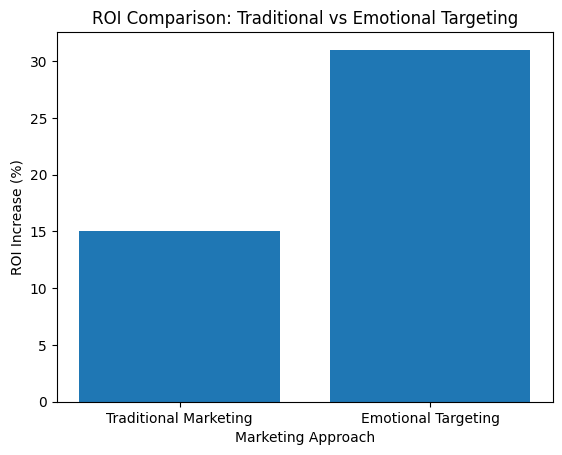
AI systems increasingly prioritize experience signals over static keywords. Emotional relevance now drives both marketing performance and AI visibility.
What Technology Powers Emotional Targeting?
Modern emotion AI platforms combine multiple technologies into a single system. The most effective stacks achieve 92-94% accuracy by using multimodal AI.
Core Technologies
- Facial Expression AI
Detects micro-expressions lasting milliseconds, revealing emotions customers may not verbalize. - Voice Emotion Analysis
Analyzes pitch, pace, pauses, and tone to identify stress, confidence, or hesitation. - Natural Language Processing (NLP)
Interprets sentiment and intent across chats, emails, reviews, and social media. - Biometric Signals
Uses heart rate variability, skin conductance, and breathing patterns from wearables. - Multimodal Fusion AI
Combines all signals into a unified emotional profile in real time. - Multimodal systems outperform single-source tools by 20–25%, directly increasing ROI.
Key Trends Driving Adoption
Emotion AI adoption is accelerating due to hyper-personalization and AI-driven customer experiences.
To deliver this level of personalization 24/7, businesses are increasingly deploying smart AI agents that can interpret emotional cues and handle complex customer interactions autonomously.
| Trend | Impact |
|---|---|
| Mood + weather personalization | +43% click-through rates |
| Cross-channel emotional consistency | Higher retention |
| Predictive emotion AI | 20% faster response |
| Entity-based content optimization | 67% more AI citations |
Brands that combine emotional data with contextual signals outperform competitors relying on static personalization.
How to Implement Emotional Targeting (Step-by-Step)
Phase 1: Audit Your Emotional Baseline
Start by mapping emotions across the customer journey.
What to analyze
- Website behavior (hesitation, exits, retries)
- Support tickets and chat logs
- Reviews and feedback
- Repeat purchase patterns
Benchmarks
- Aim for <10% frustration signals
- Identify top emotional friction points
- Audit datasets for cultural and demographic bias
This baseline defines what “success” looks like.
Phase 2: Fast Technical Integration
Emotion AI is no longer enterprise-only.
Quick implementation workflow
- Choose tools
SMBs can start at ~$100–$500/month using no-code platforms.
Enterprises may use SDKs like Realeyes or Affectiva. - Connect via APIs
Most platforms integrate easily with CRM, analytics, and ad platforms. - Create real-time triggers
Example:
If frustration detected on pricing page → show empathy message + live support option. - A/B test emotional vs neutral messaging
Formula:(Emotional conversions ÷ Neutral conversions) × 100
Many brands achieve measurable lift within 30–90 days.
Phase 3: Measure ROI
Track both short-term performance and long-term value.
| Metric | Target |
|---|---|
| Engagement lift | +23% or more |
| Conversion increase | 31% |
| Loyalty / retention | 82% |
| Payback period | <90 days |
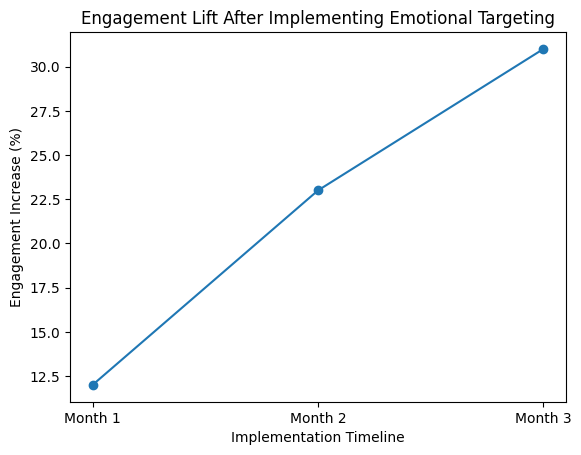
Visuals are often the fastest way to trigger an emotional response. This aligns perfectly with the rise of vision search technology, which is rapidly becoming the “killer app” for social commerce platforms.
Real-World Case Studies
Emotion AI shifts marketing from persuasion to understanding. Brands that listen emotionally win trust before they ask for action
Retail: 18% Satisfaction Growth
A fashion retailer used facial coding and sentiment analysis to detect delivery-related frustration.
Results
- +18% customer satisfaction
- +25% loyalty
- –15% support tickets
Key lesson: Proactive empathy prevents escalation.
Connected TV Advertising: 30% Repeat Views
CTV ads were matched to the emotional tone of content in real time.
Results
- +30% repeat viewing
- +42% ad engagement
- 2.5× ROAS
B2B Banking: 43% Loyalty via Transparency
A bank used voice emotion AI with clear opt-in messaging.
Results
- +43% loyalty
- +28 NPS points
- 78% voluntary opt-in
Insight: Transparency increases trust and adoption.
Ethical AI: How to Do This Responsibly
Emotion AI must be deployed ethically to maintain trust and comply with regulations.
Compliance Essentials
| Requirement | Best Practice |
|---|---|
| Consent | Clear opt-in for biometric analysis |
| Transparency | Public explanation of emotion analysis |
| Bias audits | Regular third-party testing |
| Data security | End-to-end encryption |
Ethical implementation improves E-E-A-T signals, which also affects AI search visibility.
Emotion AI Tools Comparison
| Platform | Use Case | Price | Accuracy |
|---|---|---|---|
| Realeyes | Video & facial emotion | $99/mo | 92% |
| Affectiva | Multimodal | $500/mo | 90% |
| Phable | CX analytics | Custom | 88% |
| EmotionTrac | Ad testing | $0.50/test | 88% |
| Entropik | EEG / eye-tracking | $299/mo | 94% |
| GumGum | Contextual ads | $1,000/mo | 89% |
Free starter stack: Google NLP API + Zapier workflows.
How to Future-Proof Emotional Targeting
Predictive Emotion AI
Advanced systems now anticipate emotional changes before they happen:
- Checkout hesitation
- Repeated page refreshes
- Voice stress spikes
This enables proactive support instead of reactive fixes.
Optimizing for AI Search (GEO / AEO)
To appear in ChatGPT, Google AI Overviews, and Perplexity:
GEO Checklist
- Use entity-rich language, not keyword stuffing
- Answer questions clearly and directly
- Add FAQ schema
- Cite authoritative sources
- Maintain fast, secure, structured pages
FAQs
What is real-time emotional targeting?
It is the use of AI to detect customer emotions and personalize experiences instantly.
Is emotional targeting ethical?
Yes, when implemented with transparency, consent, and bias audits.
Does emotional targeting really increase ROI?
Yes. Many brands report up to 31% higher ROI and 82% loyalty.
Can small businesses use emotion AI?
Yes. No-code tools make it affordable for SMBs.
Is emotion AI legal under GDPR?
Yes, with explicit consent and clear disclosure.
Final Takeaway
Real-time emotional targeting delivers 31% higher ROI by aligning AI-powered empathy with ethical, human-centered marketing.
As generative AI replaces traditional search, emotional intelligence becomes the new competitive advantage. Brands that combine emotion AI, transparency, and AI-search optimization will dominate both customer experience and digital visibility.
Who This Is For
This guide is for CMOs, growth marketers, founders, product leaders, and SEO professionals exploring emotion AI, real-time personalization, or generative AI optimization.
Who This Guide Is Not For
If you’re looking for quick hacks, keyword stuffing tactics, or non-consensual data exploitation, this approach is not for you.
Explore More Insights:
- Why Traffic is Down but Revenue is Up
- Check Your AI Visibility (52 Tools)
- Real-Time Emotional Targeting & ROI
- Top AI SEO Tools for 2025
- Content Structures for ChatGPT & Claude
- Recover Google Business Profiles (AEO Guide)
- Technical SEO for WooCommerce
- SEO in 2025: Context & Geo
- How GEO Revolutionizes AI Overviews
- AI Agents & Customer Experience
- Vision Search: The Social Commerce Killer App
- Retail Media Networks 2.0
- Future of Retail: Vision & Sense Search