
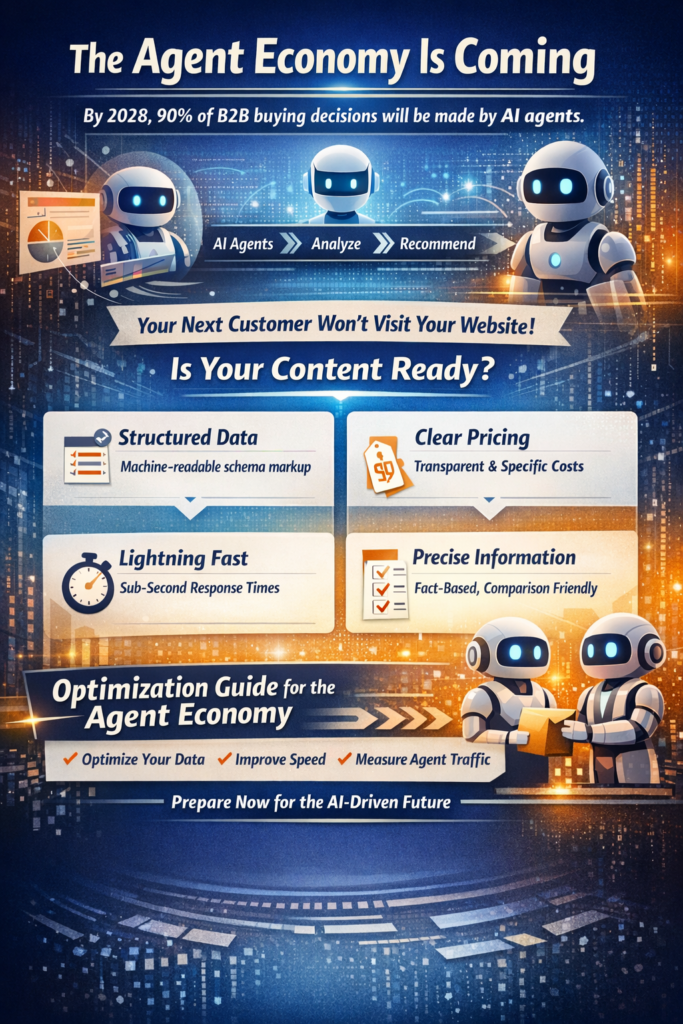
By 2028, 90% of B2B buying decisions will be AI-agent intermediated. Is your content ready for customers who never visit your website? Here’s your complete optimization guide for the agent economy.
Your next customer won’t visit your website. They won’t read your blog. They won’t fill out your contact form.
Instead, their AI agent will research your competitors, analyze your offerings, compare pricing, evaluate reviews, and make a purchase recommendation – all without a single human ever seeing your carefully crafted marketing copy.
This isn’t science fiction. According to Gartner’s latest research, 90% of B2B buying decisions will be AI-agent intermediated by 2028. That’s just two years away.
KEY INSIGHT
Autonomous AI agents don’t browse like humans. They don’t get distracted by design. They don’t respond to emotional appeals. They scan, parse, compare, and decide – in milliseconds. If your content isn’t machine-readable, you’re already invisible.
In this comprehensive guide, you’ll discover exactly how to optimize your content, structure your data, and position your business for the agent economy. We’ll cover everything from technical implementation to strategic positioning, backed by real-world data and actionable frameworks.
Let’s dive in.
What Are Autonomous AI Agents? (And Why They’re Different from Chatbots)
First, let’s get clear on what we’re talking about. AI agents aren’t just advanced chatbots. They’re fundamentally different systems with distinct capabilities:
Chatbots vs. Autonomous Agents
Traditional AI Chatbots:
- Reactive: Respond to user prompts
- Limited context: Single conversation scope
- No autonomy: Can’t initiate actions without prompts
- Single-turn thinking: Answer question, end interaction
Autonomous AI Agents:
- Proactive: Initiate research and actions independently
- Multi-step reasoning: Execute complex research workflows
- Goal-oriented: Work toward objectives over extended periods
- Tool integration: Use APIs, databases, external systems
- Decision-making: Evaluate options and make recommendations
Real-World Examples of AI Agents Today
You’re already interacting with early-stage autonomous agents:
ChatGPT with Plugins/GPTs: Can search the web, access databases, perform calculations, and chain multiple actions together to accomplish complex tasks.
Perplexity Pro: Conducts autonomous research by querying multiple sources, synthesizing information, and providing comprehensive answers with citations.
Google AI Mode (Gemini): Integrates with Google Shopping, Maps, and other services to provide product recommendations and local business suggestions.
Microsoft Copilot: Accesses Microsoft 365 data, creates documents, schedules meetings, and performs workflow automation across enterprise systems.
These are just the beginning. As we’ll explore, fully autonomous agents will soon handle entire purchasing workflows from research to final transaction. To learn more about how AI agents are transforming customer experience, check out our deep dive on AI Agents & Customer Experience.
How Autonomous Agents Search Differently Than Humans
Understanding how agents operate is crucial to optimizing for them. Here are the fundamental differences:
1. Structured Data Over Narrative Content
Humans enjoy stories, emotional appeals, and creative copywriting. AI agents prioritize machine-readable structured data.
What humans read: Our revolutionary platform transforms the way businesses approach customer engagement, delivering unparalleled results through cutting-edge AI technology.
What agents read: Product: CRM Software | Category: Customer Engagement | Technology: AI-powered | Pricing: $99/month | Features: automation, analytics, integration | Support: 24/7 | Implementation: 14 days
Agents need facts, specifications, and comparable data points – not marketing copy. If you want to understand how to structure content for both traditional SEO and AI systems, our guide on Content Structures for ChatGPT & Claude provides detailed frameworks.
2. Multi-Step Research Patterns
Humans might visit 3-5 websites during research. AI agents query 10-50+ sources in seconds, synthesizing information across multiple queries:
Step 1: What are the top CRM platforms for small businesses?
Step 2: Compare pricing between top 5 results
Step 3: What integrations does finalist offer?
Step 4: Review customer ratings for finalist
Step 5: What are the implementation timelines?
Your content needs to be discoverable and parseable at each stage of this research chain. For tools to track your AI visibility across these multi-step journeys, see our comprehensive list of 52 Tools to Check Your AI Visibility.
3. Speed Requirements: Milliseconds Matter
Humans tolerate 2-3 second page loads. AI agents expect responses in under 500 milliseconds. Technical performance isn’t optional – it’s a ranking factor.
Critical technical requirements:
- Server response time under 200ms
- First Contentful Paint under 1.2s
- Time to Interactive under 3s
- API response times under 100ms
If you’re running an e-commerce store, our Technical SEO for WooCommerce guide covers essential optimizations for speed and performance.
4. Zero Tolerance for Ambiguity
Humans can infer meaning from context. AI agents need explicit clarity:
Ambiguous (bad for agents): Competitive pricing
Explicit (good for agents): $99/month for up to 10 users, $199/month for up to 50 users
Vague (bad for agents): Fast implementation
Specific (good for agents): 14-day implementation timeline with dedicated onboarding specialist
Generic (bad for agents): Industry-leading support
Concrete (good for agents): 24/7 chat support, average response time 3 minutes, 99.8% satisfaction rating
Agent-Friendly Content Architecture: What You Need to Implement
Now let’s get practical. Here’s exactly what you need to implement to optimize for autonomous agents:
1. Comprehensive Structured Data (Schema Markup)
Structured data is the language AI agents speak. Without it, your content is essentially invisible to autonomous systems.
Essential Schema Types for Agent Optimization:
Product Schema
- Name, description, image, brand
- Price with currency, priceCurrency
- Availability status (InStock, OutOfStock, PreOrder)
- Review ratings and count
- SKU, GTIN, MPN (product identifiers)
Service Schema
- Service type and description
- Provider organization
- Area served (geographic coverage)
- Pricing structure
FAQPage Schema
- Common questions with detailed answers
- Machine-readable Q&A pairs
HowTo Schema
- Step-by-step process documentation
- Time requirements and supplies needed
- Implementation instructions
Organization Schema
- Company name, description, and logo
- Contact information (phone, email, address)
- Social media profiles
- Service areas and offerings
Understanding the broader context of where SEO is headed in 2026 will help you prioritize these technical implementations. Read our analysis on SEO in 2025: Context & Geo to see how these factors integrate.
2. Information Density: Data Tables Over Prose
AI agents scan for facts, not storytelling. Organize information in scannable, comparable formats:
Instead of this (prose):
Our Enterprise plan offers advanced features including unlimited users, priority support, custom integrations, and advanced analytics, all for a competitive monthly rate with annual billing options available.
Use this (structured table):
Plan: Enterprise
Price: $299/month (annual), $349/month (monthly)
Users: Unlimited
Support: Priority (24/7, under 1hr response)
Integrations: Custom API, unlimited connections
Analytics: Advanced, custom reports, real-time dashboards
3. Transparent Pricing Information
AI agents cannot and will not recommend solutions without clear pricing. Contact us for pricing eliminates you from consideration.
Required pricing elements:
- Specific dollar amounts (not starting at or competitive rates)
- Billing frequency (monthly, annually, one-time)
- What’s included at each price point
- Any usage limits or caps
- Additional costs (setup fees, add-ons)
4. Comparison-Friendly Specifications
Agents constantly compare your offering against competitors. Make comparison easy:
Create specification sheets with:
- Feature lists with checkmarks (yes/no clarity)
- Quantifiable metrics (not faster but 2.3x faster)
- Technical specifications (API rate limits, storage capacity, bandwidth)
- Compatibility information (platforms, integrations, requirements)
- Support levels (response times, availability, channels)
Platform-Specific Agent Optimization
Different AI platforms have different agent capabilities. Here’s how to optimize for each:
ChatGPT with Plugins & Custom GPTs
ChatGPT’s agent capabilities come through plugins and custom GPTs. These can access your data, perform actions, and integrate with external systems.
Optimization tactics:
- Create API documentation that GPTs can read and understand
- Structure content for GPT retrieval (clear sections, semantic headings)
- Provide comprehensive FAQ content in structured format
- Include actionable next steps in every response (Book a demo here: link)
Perplexity Pro Search
Perplexity’s Pro mode conducts deep research across multiple sources simultaneously, synthesizing information in real-time.
Optimization tactics:
- Provide unique data points that can be quoted
- Structure content for real-time discovery (update frequently)
- Use explicit source attribution to build authority
- Include direct links to relevant pages (Perplexity shows links to users)
For advanced strategies on how AI systems like Google’s Gemini are revolutionizing search results, see our guide on How GEO Revolutionizes AI Overviews.
Google AI Mode (Gemini)
Google’s AI Mode integrates with Shopping Graph, Maps, and other Google services to provide comprehensive product and service recommendations.
Optimization tactics:
- Optimize Google Business Profile completely (hours, services, attributes)
- Implement Google Shopping feeds with comprehensive product data
- Leverage Google Merchant Center for e-commerce
- Use structured data extensively (Google reads it for AI Mode)
If you need to recover or optimize your Google Business Profile for maximum AI visibility, our AEO Guide to Recover Google Business Profiles provides step-by-step instructions.
Microsoft Copilot for Enterprise
Copilot agents access Microsoft 365 data, create documents, and automate workflows across enterprise systems.
Optimization tactics:
- Create Microsoft Graph-compatible data structures
- Provide business data in formats Copilot can ingest (Excel, SharePoint)
- Structure case studies and documentation for enterprise decision-makers
- Include ROI calculators and business impact metrics
Measuring Agent-Driven Performance
How do you know if your agent optimization is working? Traditional analytics won’t capture agent activity. Here’s what to track:
1. Agent-Specific Traffic Patterns
User agent strings to monitor:
- ChatGPT-User (OpenAI’s web crawler)
- PerplexityBot (Perplexity’s crawler)
- Google-Extended (Gemini’s training crawler)
- ClaudeBot (Anthropic’s crawler)
2. Brand Mention Frequency in AI Responses
Monitor how often AI agents cite your brand when users ask relevant questions. Test queries like:
- What are the best [your category] for [use case]?
- Compare [your product] vs [competitor]
- Which [service type] should I choose for [specific need]?
3. Conversion Attribution for Agent-Assisted Purchases
Track how AI agent research influences conversions:
- Survey new customers: How did you discover us? (include AI assistant recommendation option)
- Monitor direct traffic spikes after AI platform updates
- Track branded search increases following agent citations
- Analyze conversion patterns of users with unusually short time-on-site (agent-researched users convert faster)
Understanding how your traffic patterns and revenue metrics interact is crucial for agent optimization. Our analysis of Why Traffic is Down but Revenue is Up explains these shifting dynamics.
Future-Proofing for the Agent Economy
The agent economy is evolving rapidly. Here’s what’s coming and how to prepare:
2027-2028 Predictions
Agent-to-Agent Negotiations: AI purchasing agents will negotiate directly with AI sales agents, comparing offers and finalizing deals without human intervention. Prepare by creating agent-readable pricing tiers, discount structures, and negotiation parameters.
Fully Autonomous Procurement: Agents will handle entire B2B purchasing cycles from requirements gathering through contract execution. Ensure your contracts, terms of service, and SLAs are machine-readable and agent-negotiable.
Voice-Activated Agent Commerce: Voice assistants will become primary purchasing interfaces. Optimize for voice search patterns and conversational queries. For insights on the future of visual and sensory search, explore our article on Vision Search: The Social Commerce Killer App.
Cross-Platform Agent Coordination: Agents across different platforms will share information and coordinate recommendations. Build consistent entity presence across all AI platforms to benefit from cross-platform reputation.
Agent Optimization for Retail & E-Commerce
Retail and e-commerce businesses face unique challenges and opportunities in the agent economy. AI shopping assistants are becoming primary discovery channels for products.
Essential product data elements:
- Complete, accurate product titles with key attributes
- Detailed descriptions with specifications, materials, dimensions
- High-quality images (multiple angles, zoom capability)
- Real-time pricing and availability
- Shipping information (costs, timelines, free shipping thresholds)
- Customer reviews (quantity and average rating)
The future of retail is being transformed by AI-powered experiences. Learn more about emerging trends in our comprehensive guide to Retail Media Networks 2.0 and our analysis of the Future of Retail: Vision & Sense Search.
Your 7-Step Agent Optimization Action Plan
Ready to get started? Here’s your implementation roadmap:
- Audit current content for agent readability: Review your top 20 pages. Do they have structured data? Clear pricing? Specifications?
- Implement comprehensive schema markup: Start with Product, Service, Organization, and FAQPage schemas on key pages.
- Create agent-friendly specification pages: Build dedicated pages with pricing tables, feature comparisons, and technical specs.
- Optimize technical performance: Improve server response times, reduce page load speed, optimize API endpoints.
- Build measurement systems: Set up tracking for agent traffic, brand mentions, and conversion attribution.
- Test with AI agents: Ask ChatGPT, Perplexity, and Gemini about your offerings. See what they recommend.
- Monitor and iterate: Track citation frequency, adjust based on performance, continuously improve.
For comprehensive tooling to support these efforts, consult our list of the Top AI SEO Tools for 2025.
The Bottom Line: Start Optimizing for Agents Now
The shift to autonomous AI agents isn’t coming – it’s already here. Every day you wait to optimize for agents is a day your competitors gain ground in AI-intermediated discovery.
The good news? Most businesses haven’t started. You have a massive first-mover advantage if you act now.
Key takeaways:
- AI agents prioritize structured data over narrative content
- Transparent pricing and specifications are non-negotiable
- Technical performance directly impacts agent accessibility
- Different platforms require different optimization approaches
- Measurement requires new metrics and attribution models
- The agent economy will fundamentally change B2B and B2C commerce
Your content strategy needs to serve both human and AI audiences simultaneously. The dual-layer approach – human-readable wrapper with agent-readable core – is how you win in both channels.
Need Help Optimizing for AI Agents?